Comprehensive Guide to Sigmacell Cellulose Type 20 Properties and Applications
Understanding Sigmacell Cellulose Type 20: A Comprehensive Guide
Sigmacell cellulose Type 20 is a highly purified, microcrystalline cellulose (MCC) widely used across diverse industries including pharmaceuticals, food, cosmetics, and industrial applications. Its exceptional binding, disintegrating, and flow properties make it a crucial ingredient in tablet manufacturing, as a stabilizer in food products, and as a texture enhancer in cosmetics. This article provides a detailed overview of Sigmacell cellulose Type 20, its properties, applications, and benefits. Understanding the specific characteristics of this MCC type is vital for achieving optimal product performance and quality. You can explore a range of cellulose products at HPMC Powder.
What is Sigmacell Cellulose Type 20?
Sigmacell cellulose Type 20 is a specifically engineered form of microcrystalline cellulose (MCC). MCC is derived from high-quality wood pulp that has undergone controlled hydrolysis, breaking down the larger cellulose molecules into smaller, crystalline particles. Type 20 refers to the average particle size, indicating a finer particle distribution compared to other Sigmacell types. This finer particle size results in improved compressibility and tablet hardness, making it especially valuable in pharmaceutical formulations. The manufacturing process ensures high purity and consistent quality, making it a reliable excipient for demanding applications. Explore our complete MCC range at HPMC Powder.
Key Highlights: High purity, controlled particle size (Type 20), excellent compressibility, and superior binding properties. Ideal for dry granulation and direct compression tablet formulations.
Applications of Sigmacell Cellulose Type 20 Across Industries
The versatility of Sigmacell cellulose Type 20 extends across numerous industries. In the pharmaceutical sector, it’s a crucial excipient in tablet and capsule formulations, acting as a binder, diluent, and disintegrant. Within the food industry, it’s used as a stabilizer, thickener, and anti-caking agent in processed foods. Cosmetically, it functions as a texture enhancer, emulsion stabilizer, and absorbent in creams, lotions, and powders. Furthermore, it finds applications in industrial areas like paints, coatings, and adhesives, leveraging its excellent flow and binding capabilities.
Key Application Areas:
• Pharmaceutical Tablets and Capsules
• Food Stabilization and Texturing
• Cosmetic Formulations
• Industrial Coatings and Adhesives
Sigmacell Cellulose Type 20 vs. Other MCC Grades: A Detailed Comparison
Different grades of MCC are available, each tailored to specific applications. Sigmacell cellulose Type 20 stands out due to its fine particle size and resulting properties. Compared to coarser grades like Type 101 or Type 102, Type 20 exhibits superior compressibility and produces tablets with higher hardness. This is particularly advantageous for formulations requiring robust tablets with quick disintegration. The table below highlights a comparison of key characteristics.
Product Specifications and Quality Control
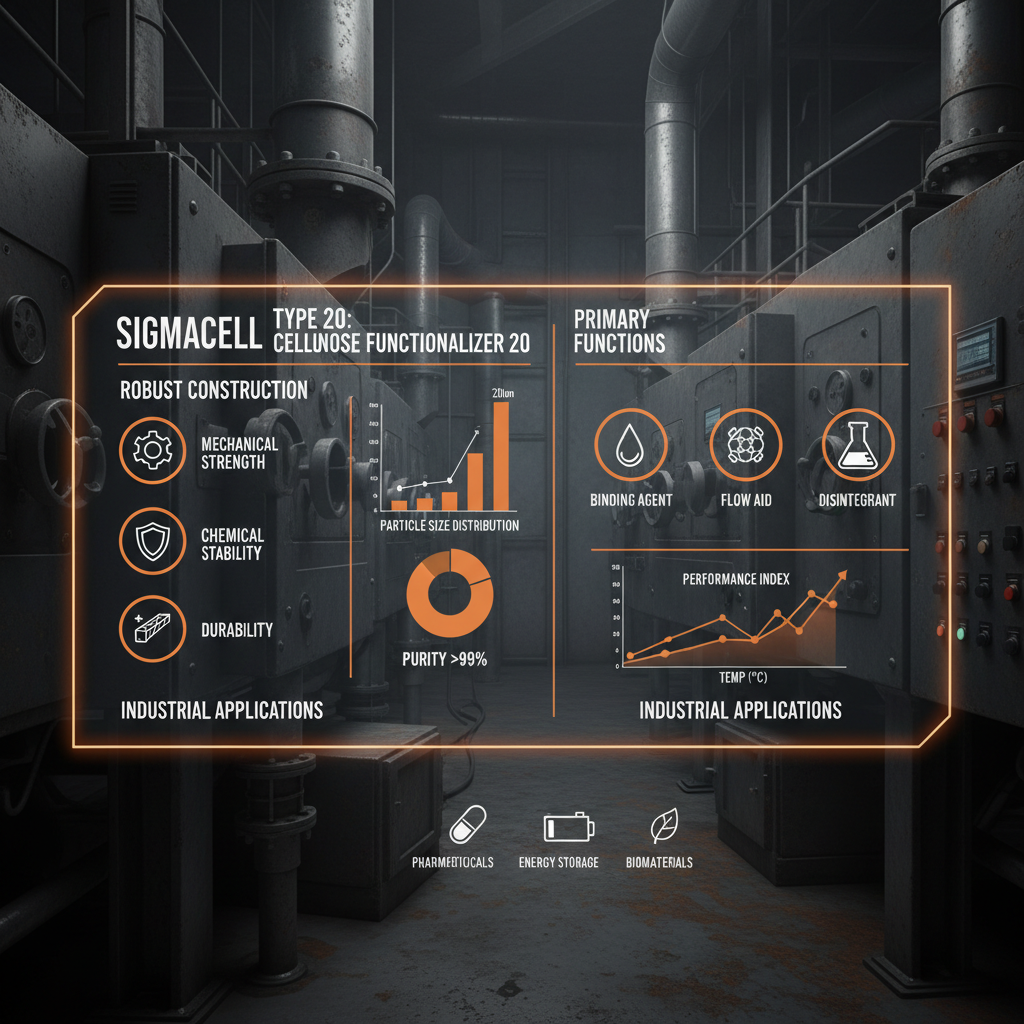
HPMC Powder ensures stringent quality control measures are in place throughout the manufacturing process of Sigmacell cellulose Type 20. This includes rigorous testing for moisture content, particle size distribution, heavy metals, and microbial contamination. The product meets the pharmacopoeial standards (USP, EP, JP) guaranteeing its suitability for pharmaceutical applications. Here’s a summary of key specifications:
Conclusion: Sigmacell Cellulose Type 20 - Your Reliable Excipient Partner
Sigmacell cellulose Type 20 is a versatile and high-quality excipient that offers superior performance in diverse applications. Its fine particle size, excellent compressibility, and adherence to stringent quality standards make it a preferred choice for pharmaceutical, food, cosmetic, and industrial manufacturers. For reliable sourcing of premium Sigmacell cellulose Type 20, visit HPMC Powder today.
Frequently Asked Questions (FAQs)
What is the recommended storage condition for Sigmacell Cellulose Type 20?
Sigmacell Cellulose Type 20 should be stored in a cool, dry place, protected from direct sunlight and moisture. Ideal storage conditions are temperatures below 25°C and relative humidity below 65%. Proper storage prevents degradation and maintains the product's quality and performance. Keep the container tightly closed when not in use. Avoid storing near strong oxidizing agents or incompatible materials.
Is Sigmacell Cellulose Type 20 compatible with all pharmaceutical ingredients?
Sigmacell Cellulose Type 20 generally exhibits excellent compatibility with a wide range of pharmaceutical ingredients. However, it is always recommended to conduct compatibility studies with specific excipients and active pharmaceutical ingredients (APIs) to ensure there are no adverse interactions. Factors like pH, ionic strength, and temperature can influence compatibility. Consulting with a formulation expert is advised for complex formulations.
What is the typical particle size range for Sigmacell Type 20?
Sigmacell Type 20 is characterized by a relatively fine particle size, typically ranging from 50 to 100 micrometers. This finer particle distribution contributes to improved compressibility and tablet hardness compared to coarser MCC grades. The particle size distribution is carefully controlled during manufacturing to ensure consistent product performance. Please refer to the Certificate of Analysis (CoA) for specific batch details.
Can Sigmacell Cellulose Type 20 be used as a direct compression excipient?
Yes, Sigmacell Cellulose Type 20 is well-suited for direct compression applications due to its excellent compressibility and flow properties. It helps achieve high tablet hardness and reduces the need for granulation steps, streamlining the manufacturing process. However, the suitability for direct compression also depends on the characteristics of other excipients and the API used in the formulation.